Claims and provenance
Every fact Area O1 holds is a claim that quotes its source exactly, so you can always trace it back to what was read.
Observations
When a connector reads something (a GitHub API response, an email, a page, a file you uploaded), Area O1 saves it unchanged as an observation:
- the content goes to
memory/sources/<sha256>.<ext>, named by its SHA-256 hash, so the same content is stored once; - a line in
memory/observations.jsonlrecords the connector, the source URL, when it was captured, the hash, and the source's tier.
The tier says how far a source can be trusted on its own:
| Tier | Meaning |
|---|---|
tier1, tier2, tier3 |
Official rule sources in the knowledge vault: primary law and agency pages, adjudication, secondary. |
platform |
A service's own API, such as GitHub or Hugging Face. |
user |
A document you filed. |
self_reported |
Your own words, such as imported chat history or a note from an AI tool. Useful for trackers, never proof. |
Claims
A claim is one fact drawn from an observation. Each claim has:
subject: what it's about, an entity id such asartifact:github:mayachen/fastgrad,predicateandvalue: for examplestarsand1340,stagefor activities:invited,completed,submitted,published... (see Invited vs completed),excerpt: the exact words from the snapshot that support it,excerpt_startandexcerpt_end: where those words sit in the snapshot, by character offset,valid_from: when it became true in the world, andrecorded_at: when Area O1 learned it,extracted_by: the connector, model or person that read it, and aconfidenceof high, medium or low.
Area O1 refuses a claim whose excerpt isn't found word for word in its snapshot. areao1 validate re-checks every claim: it confirms each excerpt is still at its offsets and each snapshot still matches its hash, so an edited snapshot is caught.
Append-only memory
The memory files in memory/ only grow. Nothing is edited or deleted in place:
| File | Holds |
|---|---|
observations.jsonl |
Raw captures. |
entities.jsonl |
People, artifacts, organizations, venues, events. |
claims.jsonl |
One fact per line, with its excerpt and offsets. |
edges.jsonl |
Links between them. |
decisions.jsonl |
Your approve and reject decisions. |
Lines append cleanly in Git, so the history of your case is easy to diff. A SQLite index in .areao1/cache/ speeds up queries; it can be deleted and is rebuilt from these files. See ADR 0004.
Links between claims
Edges connect the pieces. The ones you'll see most:
| Edge | Meaning |
|---|---|
DERIVED_FROM |
A claim came from this observation. |
ABOUT |
A claim is about this entity. |
SUPERSEDES |
A newer claim replaces an older one on the same subject and predicate. |
CONTRADICTS |
Two claims disagree. The Memory page shows them in red. |
REVIEWED_BY |
A claim has a review decision. |
CITES |
An exhibit relies on this claim. |
When a source says something new (fastgrad went from 1,200 to 1,340 stars), Area O1 appends a new claim with a higher version that SUPERSEDES the old one. The old claim stays, so the history is kept. When a second, independent connector reports the same value, the claim is corroborated.
Review status
A claim's status is worked out from the files, not stored on it:
- approved or rejected: your latest decision, made when you accepted or rejected the Inbox item that rests on it,
- corroborated: no decision yet, but two independent connectors saw the same value,
- proposed: everything else.
Approval records your decision. It doesn't certify that the fact is true or legally sufficient. Agents are told to draft only from claims that are approved and current (nothing supersedes them), and the Letters page enforces it.
As-of queries
Because each claim has both valid_from and recorded_at, you can ask what Area O1 believed on a given day: what was true by then and already known by then. This answers questions like "what were my metrics on filing day?" and powers the trend charts and "what changed since my last session". MCP clients ask it with query_claims(entity, as_of) (see MCP tools).
W3C PROV
The model maps onto W3C PROV, the standard vocabulary for provenance: a source is a prov:Entity, extraction and review are prov:Activity, and connectors, models and you are prov:Agent. DERIVED_FROM corresponds to prov:wasDerivedFrom. The get_provenance MCP tool returns a small prov block in these terms.
The Memory page
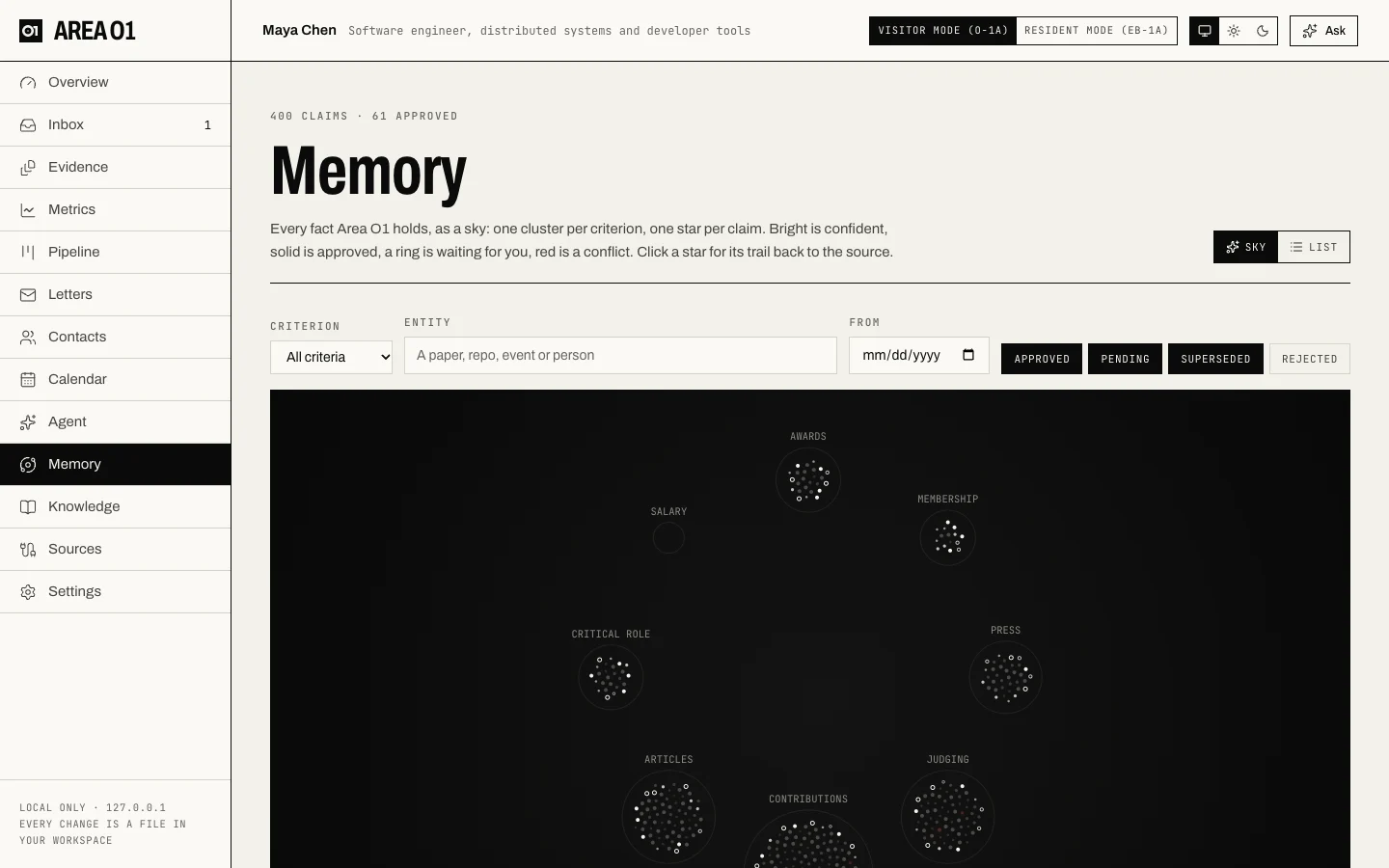
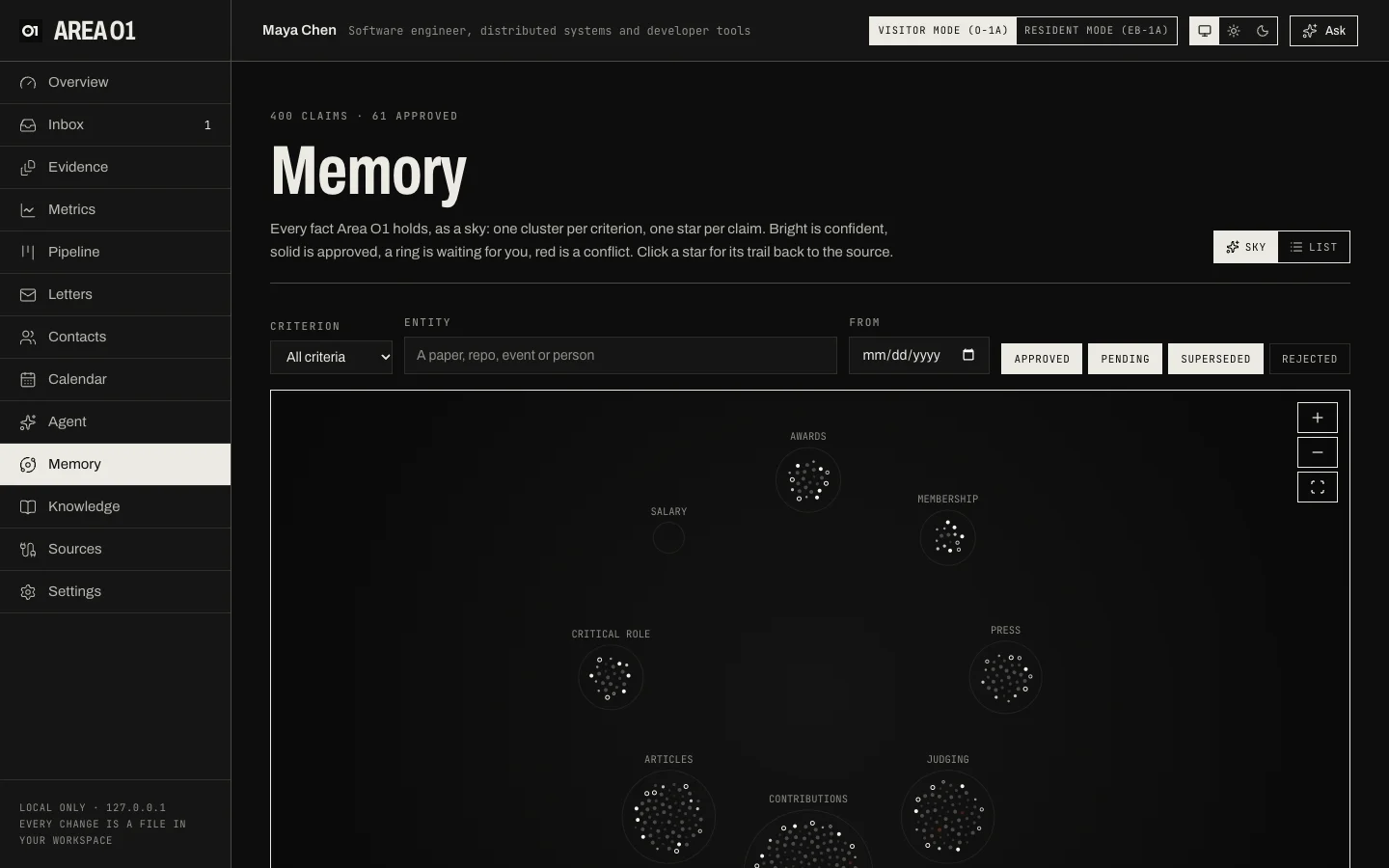
The Memory page draws every claim as a star, one cluster per criterion. Brighter stars are higher confidence, solid ones are approved, rings are waiting for your review, faded ones are superseded, and red ones are in a conflict. You can filter by criterion, entity, status and date, and replay the case over time.
Click a star to open its trail: the claim, the verified excerpt, the raw source, the reviews, earlier versions and the exhibits that cite it.